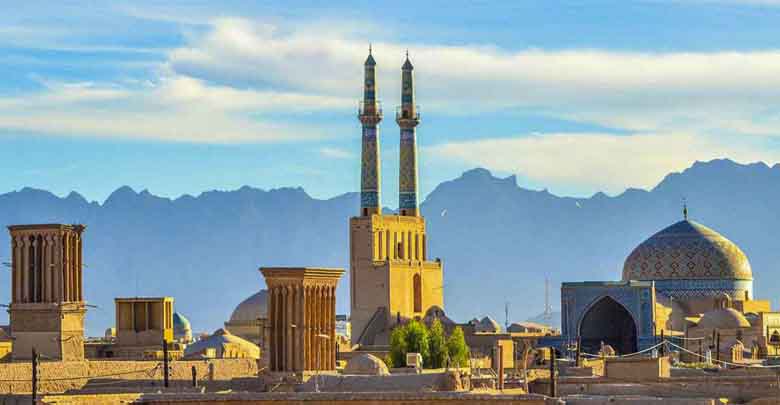
Historic City of Yazd
With the
great wind towers soaring above a labyrinth of adobe roofs, the historic old
city of Yazd is proud to be known as the city of windcatchers in the world. The
second oldest town and the first adobe city on earth are also the two
significant characteristics of Yazd. These features are so alluring that they
nudge us into visiting this desert city that can boost the history of Iran’s
land brick by brick to the world.
Listed
as a UNESCO World Heritage
Site in 2017, the world has considered Yazd as the owner of one of
the most striking cultural heritages in different historical eras of Iran. What
is specifically important in the midst of this vast volume of history is the
preservation of the traditional and historical context of a significant part of
Yazd, which is tied to the preservation of the culture and civilization belong
to the people of this ancient land. Now, let’s dive right in the details about
Yazd, the mother of Adobe cities of the world.
Yazd is a city settled in the middle of the Iranian Plateau,
near the Spice and Silk Road, which is called by various names, such as the
city of qanats, the city of wind catchers, the city of sweets, and the city of
fire and sun. There is no doubt that during history, people in Yazd, generation
after generation, got adapted to their surrounding desert.
The very unique Persian
architecture of Yazd is the phenomenon of this human-desert interaction. Yazd
bears witness to the brilliant use of restricted resources for survival in the
desert. In addition, an extraordinarily intricate construction system of
earthen architecture and adaptation of living to the unfriendly environment are
significant indicators of residences’ genius.
Most notably, the water
system of qanats has benefited Yazd a lot. Fortunately,
Yazd’s earthen architecture has resisted the modernization that demolished
numerous earthen towns. Yazd has preserved its traditional districts and
houses, the qanat system, and its historical attractions to respect its
conditions of authenticity. There are some elements that make Yazd well known
and you should consider visiting them in Yazd tours like:
·
Zoroastrian fire
temples
·
Windcatchers
·
Ab Anbars (cisterns)
·
Qanats (underground channels)
·
Yakhchals (coolers),
Persian handicrafts
·
Handwoven cloth
(Persian termeh)
·
Silk weaving, Persian
cotton candy
·
Time-honored
confectioneries
To explore the significant attractions of the city, take the time to read the following parts.

Probing Yazd’s Attractions
Fahaadan Historic Neighborhood
In every
corner of Yazd, an attraction awaits us to be explored. So let us start by
walking in the Fahaadan historic neighborhood,
where the aristocrats used to live in the past times. Exploring this authentic
area is like entering an enjoyable adobe maze, where the sweet aroma of clay
has filled the atmosphere. Walking in the narrow alleys, screened by imposing
mud walls, will transform you back in history.
Fahaadan neighborhood offers the visitors a collection of courtyards and teahouses, historical mosques and houses, such as Lariha House, and handicraft shops to discover. The tall windcatchers and domes above the houses, courtyards, and thick earthen walls remind visitors of the beauty of Yazd’s traditional architecture. These elements altogether generate a good microclimate for the warm and dry city of Yazd, where the yellow and brown color of buildings reveals this claim.


Zoroastrian Attractions
Have you ever known that Yazd is
a city that celebrates different religions, coexisting in peace, including
Islam, Judaism, and Zoroastrianism? Therefore, it provides an opportunity to
visit monuments of religious, architectural, and historic importance now.
The Zoroastrian
Fire Temple of Yazd is our host. This is a beautiful
building, with the Achaemenid architecture, which sits in the center of a green
yard, in front of which there is a small circular pool, and the pattern of
“Forouhar” manifests on the front of the mansion. This mentioned impressive
structure is home to a fire flame burning for 1500 years.

It is believed that the fire was brought from Anahita Fire
Temple in Fars Province. For this reason, it has attracted special attention
and respect for people as a holy place to Zoroastrians. To enter the
Zoroastrian Fire Temple, everyone needs to observe special etiquette, such as
wearing clean and decent clothes, having a white hat or scarf, and wearing no
shoes.
Zoroastrian Towers of Silence is the next attraction to visit. We need to go outside the city to see these mysterious attractions, situated on the top of a hill in the form of two large buildings.

In the distant past, Zoroastrians left the corpses in towers to be eaten by birds. You might experience a mysterious feeling during your visit. It’s time to return to the city of Yazd.
Amir Chakhmaq Complex
Like any
other big city, such as Shiraz,
Isfahan, and Kerman that have a main ancient square, Yazd is host to a
magnificent one, called Amir Chakhmaq Square. Registered in the Iran National
Heritage List, the Amir Chakhmaq complex contains several old structures
including a bazaar, a mosque, water storage (Ab-Anbar), and a Tekyeh that all
narrate the history of this land since the Timurids dynasty.
Nowadays, this square is still
shining in Yazd as the residents hold the most important religious and social
ceremonies there.
Near the Amir Chakhmaq Square, which serves as the symbol of Yazd, we can pay a visit to the Saheb Al-Zaman Zurkhaneh. There, we can watch the cultural and traditional sport of Zurkhaneh, which has been recorded as the world-registered ritual.

Jameh Mosque of Yazd
It’s time to visit the tallest historical monument of Yazd,
known as the Jameh Mosque. This eminent architectural masterpiece holds two of
the tallest minarets of Iran. The excellent use of the blue mosaic tiles and
brickworks have made this mosque a great piece of art.